Tuesday, August 23, 2022

DiPo 2022, Day 0 - 2022.08.22

Day "0" has not much to talk about... Just a travel to half-way...

So I talk about what are the DiPo Missions!

"Di" and "Po" are the two first letters for "Didymos" and "Polymele"! These are two small bodies in the solar system! Bothe will "fly" in front of stars in two consecutive nights, and visible from the "same" region in the North of Portugal! So, on the next day, my travelling plans will take me to Oporto, to meet up with the rest of the international team that has put this joint campaign together!

(65803) Didymos is the interest of ACROS Team, and ESA, to undertake some space-mission-thing...

And (15094) Polymele is in the interest of Lucy Mission, for NASA's space-mission-thing too..

Apparently they all want to know where these asteroids are, so people on Earth -- like us -- need to observe stars being occulted by the moving rocks..

And that is what I am going to take part in :)
Didymos occultation will happen on 2022.8.25, and Polymele will be on the following day.

"M12" is not the Messier object I hinted earlier, but instead is a code for a special set of observer locations where I must be observing from... The locations for the other mission are still not final yet! Day 1 (2022.08.23), will be the day for searching for those!

Monday, August 22, 2022

DiPo 2022 Missions

 Ah-ha! A new Mission!

This afternoon a new week-long mission begins!

To keep suspense up, more details will come soon :)

But generally speaking my attributions are:

  • Observe and time 2 events!
  • Provide back-up equipment
  • Provide "communication services"
  • Geo-suggestive help :-)
  • Other international fun stuff full of knowledgeable participants!

So far only the second assignment is known, and that is M12 :-D

Have fun with wikipedia entry on M12

Messier 12 - picture by Hubble, via wikipedia.org


Wednesday, November 30, 2011

How to make an Helix: Part #2

Gravity, as we know it, has the nasty habit of being attractive. This means material left unattended in the vacuum of space tends to fall towards somewhere. Naturally, this presents very inconvenient implications in the long run for our goal of making a Planetary Nebula. It will not work to simply scatter atoms and molecules of Hydrogen, Oxygen, and Nitrogen, 200 pc away from a White Dwarf, expecting them to stay there forever shining like an over-sized gas-discharge light bulb..
Planetary Nebulae are dynamic structures, in constant expansion. Their birth may be far less explosive than Type Ia supernovae, though we can imagine some symptoms of stellar indigestion that culminate in large-scale pulsations or mass ejections. Perhaps an extreme exaggeration of how our sun often spits particles in solar storms might help illustrate how the atmosphere ends up leaving the star behind, in one big, stellar-sized "cough". We could imagine a Red Giant star pulsating through two or three such seizures before the last of them strips the core of the star naked, thus revealing the White Dwarf within.. The material then sails the stellar wind, away from the star, glowing in atomic colours..

If we would build our Planetary Nebula by leaving material lying around with no initial velocity it would all eventually fall back onto the star, causing some sort of forced refuelling of the moody White Dwarf. That could make the star angry, and likely result in heavier elements being created in an atomic fusion process.. Hmm, I just had a dangerously Ironic (Fe) thought, but its not our goal now, as fusing Iron is usually "super-novic" and would destroy our nebular creation..

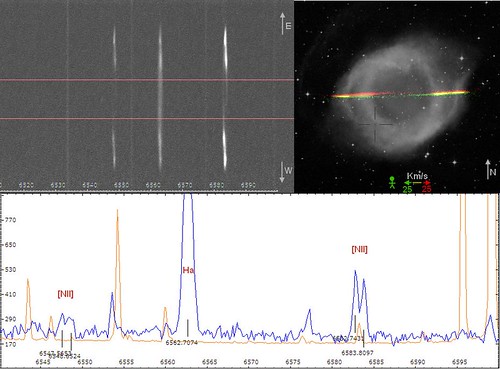
Focusing back on our goals again, for creating our Planetary Nebula we what to mimic NGC 7293, which has some really interesting concepts and features! All that ejecta mentioned will have gone out towards space. Some faster, some slower, but all away from the central star. Again spectroscopy can lend a hand here, this time in "High Resolution" (dispersion: wavelength per pixel). Dispersion high-enough to make visible the Doppler shift of the expansion fronts.
If you imagine a semi-transparent baloon that is being inflated, in the middle of the balloon you will see the central star, and aside it you will see the surface of the balloon that is moving towards you, and the other surface moving away. So, for the colour that is being emitted on the "balloon walls" we should see half of it shifted to the blue, and another half shifted to the red. Seen in the image below, this particular shift of roughly 1.7 angstroms between the two walls translated to a velocity difference of, give or take, 49 km/s along the direction of sight, making the expansion rate of the "ionization front" of half that: 24,5 km/s, just like astrophysicists had previously measured! The spectrum also lets us know which parts of the nebula are moving toward us or away, as illustrated on the right.

NGC7293 spectrum by Filipe Dias
NGC7293 Spectrum on Flickr. Spectrograph slit oriented nearly with East-West direction.


This particular colour wavelength we are looking at corresponds to a certain amount of ionization, as mentioned in the previous post. Radiation from the star reaches this area with enough intensity to ionize gas. It is thought that this ionization does not occur further outside because the density of this gas and dust prevents it. Some portion of the gas/dust may be "in the shade" from receiving UV radiation in the needed quantity to get ionized, thus we are not able to see that area in this wavelength. If we were to look at this object in CO wavelength (radio) we would find leftovers from previous mass ejections, and measuring their speeds we would find the values wikipedia states (32 and 40 km/s).

For our Nebula, we can further decorate the interior with the sort of detail we see on NGC 7293, arising from the various ejections at different velocities and their interaction with stellar wind! As result of the various ejections of gas and dust in the past, the space around the nebula has become crowded with chunks of material moving away from the star. A speedier ejection actually met up with this material left behind the now-stronger stellar wind is currently eroding its way through it. This is visible as cusps of matter that leave a cometary tail behind, as they get "eroded" by the radiation streaming out of the star.

So all this are good ideas for how to make and decorate a Planetary Nebula realistically. As a final tip, always keep in mind that a radiation-bounded nebula (where portions of if are hauntingly concealed from sight, shaded from the illuminating star) will keep people interested in it for longer time. Always keep your creations mysterious to the human eye; they always captivate new minds, and work as an excellent advertising tool for the wonders of space! I wish you the best of luck in creating your first Planetary Nebulae!

Thursday, November 10, 2011

How to make an Helix: Part #1

Haven't you ever wanted to copy something you saw? ..And to author a portion of beauty through imitation?
Imagine we wanted to replicate one of the most charismatic planetary nebulas in the sky, NGC7293 - The Helix Nebula. What would we need for that?
This object's charisma depends greatly in its size! It looks big; it is close to us; it is actually the closest Planetary Nebula to us. Something we build, to be equally amazing would need to be located near the observer, also.

One could start off with a dying Sun-like star! The dying star would evolve from the "Red Giant" to the "White Dwarf" stage of stellar life, and in the process eject material from its atmosphere. When in the White Dwarf stage, strong stellar winds would blow the gas further away, and intense ultraviolet radiation should make it glow ionizedly pretty to our eyes.

Perhaps we could use our own Sun for this purpose; the trouble being the need to wait quite some time for our star to construct something similar!
Maybe we could fake all this, and spread the material in space around an existing white dwarf, giving it positions and speeds identical to those in the Helix Nebula. This would be a faster way to "copy" the Helix, at least within our imaginative brain... However, we still need to know what material to use for the gas, so it glows in the same manner as in the Helix.
For this, spectroscopy is handy, as it allows us to peek at what colours the Nebula is shining off!
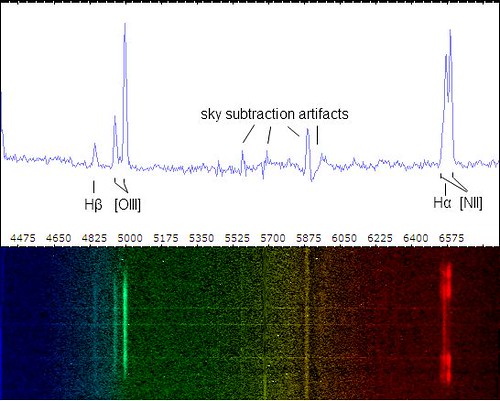
Here is a spectrum, in visible light, of the nebula across its diameter! Each colour is separated horizontally, and the the (Esat-West) diameter is represented vertically. The faint horizontal lines are actually stars, that shine in all colours like very hot bodies do.

NGC7293 spectrum by Filipe Dias
NGC7293 spectrum on Flickr.

Those colours are the result of ionizing the gas via intense radiation by the central star. visible from left to right are wavelengths of light corresponding to Hydrogen, Oxygen, then more Hydrogen and Nitrogen.

As for the quantities for each element, that is trickier to know. But we can try to match the intensity of colours, adding more or less atoms to get the right intensity of each colour. We should keep in mind, though, that what we see of this nebula is radiation-bounded; this means we only see the portion of nebula that is made visible by the radiation of the central star, and then the gas and dust of the nebula itself can cast shadow over more "invisible" and not yet ionized material.

So we now know what to put in a "New Helix" recipe; next we need to know how fast all of it should be moving in a bubble shape, to make it really realistic! For that, stay tuned for Part Two of "How to make an Helix"!

I hope this shed some light on how to properly replicate a planetary nebula, in case you ever stumble across the need for such endeavour..

Tuesday, September 06, 2011

Eppure Egli Ruota

Shortly after remaining alive -- or immediately before that -- Galileo Galilei allegedly muttered "Eppur si muove", in a legendary reference to a certain rocky planet that moves around a solar-type star in the habitable zone of our own solar system!.. Legend says he would say such a thing in presence of some irrefutable evidence that the given earthy planet would, in fact, show the aforementioned movement...
Well, I now say "Eppure Egli Ruota" inspired by this...
I took a picture of Jupiter; not a normal picture, though!.. In between the telescope and the sensor there was a weird light-wasting gadget capable of spreading wavelengths of light along one direction of the focal plane.. Science guys refer to it as a "Spectroscope"!..
The thing is it has enough resolution in picking out different wavelengths to actually reveal the Doppler effect on "stuff" moving at sufficiently fast speeds and in adequate directions. Here is what you get when pointing the slit spectrograph to Jupiter:

The horizontal "line" has a thickness identical to the diameter of the planet. The vertical dark lines are particular colors that our atmosphere absorbs. The oblique darks lines are absorption lines from the solar light itself, being reflected by the moving (turning) "surface" of Jupiter!
The inclination of the lines is intrinsically related to the speed at which the planet is turning. Calculating it only roughly, gives me a value between 8 km/s and 10 km/s that is a bit below Wikipedia's mentioned speed of 12.6 km/s. I did not have a special care in aligning the slit with Jupiter' equator, so this is well expected!
So, this Ziggy-zaggy picture is, actually, one other way of "seeing" Jupiter from Earth.. Here, Jupiter is not round-looking, it seems quite still.. Yet, "he" turns!

Sunday, July 31, 2011

A Galaxy through another one

NGC 6946 RGB by Filipe Dias
NGC 6946 RGB, a photo by Filipe Dias on Flickr.

After a complex day, last night I managed to escape to a reasonably dark place, and take my mind away from some of the worries that living people tend to have while alive..
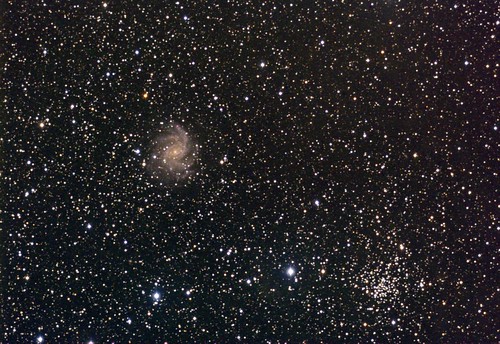
Right through most of the stars that make our own galaxy, we occasionally get a glimpse of other galaxies lying around.. This particular one, NGC6946, is "face on", easily displaying its spiral arms, and is one of those that are most "near-by" our own Milky Way galaxy. In the same picture there is an Open Cluster of stars, NGC6939, that resides in our galaxy. Lots of scattered stars are equally visible, belonging to a region just 11 degrees away from the plane of our galaxy, in the South-West corner of constellation Cepheus.

Thursday, July 28, 2011

New bolts

So, yes, I am now into astro-spectroscopy! :)
One of the big secrets about spectroscopy with reflective gratings, that few people mention, is that it can get heavy! So heavy, in fact, that your telescope may find its way into impossible balancing situations!
In order to balance the weight, I had to improvise "stuff" attached to the telescope tube in order to balance it.. It worked, but was not a pretty sight.
Today I went to the historical "Casa dos Parafusos" (bolts house) and bought 4 screws to attach a larger accessory plate to my mount so that I can attach a counterweight more securely. This 65-year old shop had a really historic feel to it, a few years ago. Two years ago I found it closed. It went through a lot of difficulties, but the PECOL group managed to "save it" last year. I was very glad to finally see it open and working! The shop was completely transformed! It now has a modern space with stuff on display, it has two desks for attending costumers, and big warehouse with all sort of bolts in stock. The shop is no longer a tourist destination, but if you need an odd bolt or a common bolt, it is still the place to go!

Tuesday, July 19, 2011

A closer look at Deneb

How close can you get to Deneb, the brightest star in constellation Cygnus?

Well, it kind of depends on how you measure "closeness".. If you think of "distance", as in a single-, two- or three- dimensional spacial measure, you could imagine "closeness" to be a specific value for that distance that is small enough compared to other reference values.. Therefore, the closest all we earthlings can physically get to Deneb is likely to be around 1400 light-years, give or take..

If you base your assumptions for "closeness" on comfort and planet-habitability concerns, you could possibly say that an observer could inhabit a big rock at a distance of -- give or take -- 245 AU from it (square root of how more luminous it is compared to our Sun, multiplied by our nicely habitable distance to our star), and still be able to drink a glass of refreshing liquid Dihydrogen Monoxide potion at ambient temperature...

Well then, what if I were to define "closeness" as, not a ratio of spacial physical distances, but instead a ratio of lengths (wavelengths) of the radiation we observe? Imagine I talk about "colour", and how close I can distinguish one colour from a more distant one! One emission or absorption from a chemical element from the other element!... Or, for instance, from one stationary element, and one moving element. Or even how colour can change with density of the material, and thus, star size!.. How is this for "closeness"?


So here is a raw spectrum (uncalibrated) from Deneb in the vicinity of H-alpha! The absorption lines in the spectrum are "rather thin", and so the star is "not very dense", and in lacking mass that can hold down its size it got big (wikipedia tells me it can be way over 100-suns-big)!
The odd V-shaped absorption in the H-alpha, on the right side of the spectrum, comes from the atmosphere of the star or things above it, whose Hydrogen atoms are absorbing radiation in a wide region. The shape of this profile actually reflects some behaviour in action.. Stellar winds, storms, and mass ejections, for instance!
The thin emission lines present, and marked as "lamp" are from a lamp of known spectrum, placed in front of the telescope, to be used for spectral calibration.

So how close did I get to Deneb? Each pixel in this graph is only 0.33 Angstroms of Deneb's colour, and it only reflects visible colours going from the so-or-so-red (640 nm) to the slightly-more-red (660 nm). This was close enough to burn quite some neurons of my brain! Ouch!

Tuesday, July 05, 2011

Recurrent Novae

Re-boom!

Expecting this? Perhaps not! Why on Earth (or outside it) would yet another "bang" be heard? You may have noticed the metaphor behind the first of a series of posts in this blog.. The first post was the "Big Bang", understandably. But at the beginning of each burst of posts, other kaboom-ish sounds would be encoded in post titles as if stellar light were sound..
While to some this blogging effort could resemble an old engine's exhaust, thumping in need of maintenance and regular use, I prefer to see it as a Recurrent-type of Nova.. One with no discernible periodicity.. One that shines brighter when it decides to..

So, do expect new posts with possibly interesting stuff attached to them..

Meanwhile... Recurrent Novae are Cataclysmic-type Variables, formed by multiple-star systems, where one of the stellar members decides to pull a prank on its close-by neighbour stealing some matter, and unleashing some rather luminous fireworks display in the process. They can happen once in "some years", denoting the short distance between stars. The most recent recorded outburst of a Recurrent Nova was that of Tau Pyxids, earlier this year, in April. It is still rather bright at (V) 8~9 mag.

Sunday, January 24, 2010

Science beyond translation..


Have you ever wanted to learn a new language?
Why would you ever want to do that?
Could it be to gain access to new ways acquiring scientific knowledge, for instance?
Euronews, an European news TV channel, has a multi-language approach to news broadcasting. It provides news in many different languages! Specifically, it provides the SAME news in different languages.. Or at least one would expect them to be the same!..
Hmm, Who do they translate the science spots? Could they be automatically translated using any famed automatic translation tool available online?

If you can understand Portuguese, I invite you to take a look at the following science spot from Euronews, "Origins of our galaxy", in Portuguese, and compare it to the same one in English.
The first obvious difference is the title, which translates from "origins of our galaxy" to "técnica fotográfica ajuda a estudar estrelas". But that is acceptable; it's like changing from "origins of our galaxy" to "photographic technique helps studying stars".
The nonsense starts revealing it self on seconds 00:26 of the video when the Portuguese version talks about the "Milky Way constellation"!.. We know a constellation is sort of an "official" asterism, that presents an easy to find figure on the sky to facilitate searching for a given "place" up there. A constellation is not a galaxy.
The next piece of video nonsense comes at 2:24, where a scientific acronym gets translated. In the video, MAD, or Multi-conjugate Adaptive optics Demonstrator, is turned into "Multi-Conjugação Adaptativa e Demonstradora Adaptável do Sistema Óptico"! Which I can re-translate to english so you (might) understand: "Adaptive Multi-conjugation and Adaptable Demonstrator of the Optical system". I would love to see how this gets translated to Portuguese again!
Anyway, the most serious part is still to come. The Portuguese video mentions the VLT to "use an infra-red system"! Ooooo! It's almost like one of those mysterious black boxes that are stored next to the telescope mount, just 2 meters away from the instruments' power supply unit.. A special IR-system that changes light, making it a superb source of scientific information!... Well... The English video simply says that VLT is meant to "observe light in the Infra-Red", which is either a slightly, or just a totally different thing! It spoils all the magic that a super-secret I.R. System box could spell onto the observation data...

Oh well, I still wish I had one of those Multi-Optical Adaptational Conjugal Demonstrator Systems... Or was it a Multi-Adaptable Optics Adaptation System Demonstration Thing?...

Thursday, February 12, 2009

Find Wally.. or in this case, Rémi! :)


Today's APOD spawned an interesting challenge!
It seems Daniel López, whom I personally don't know, was at the access road to the VTT on the 23rd of January and took a picture at the sky, facing West, pointing just above the astronomer-red light-glowing dome of Gregor telescope (the other German Solar Telescope at Tenerife).

I am not sure how the photo was taken, It could have been a camera on a tripod doing several short exposures that were aligned and averaged together later. But it could be also a camera on some sort of equatorial mounting. I would bet on the first, more portable option, because the amount of "smear" in the image does not seem quite uniform, presumably arising from the combination of images with some distortion (very common on wide-angle lenses). The center appears ok because it is distortion free, and thus not influenced by afine transformations that align images in common image processing software packages.

Anyway, apart from the beautiful picture, you see a wonderful sky.. And, us MONSters, immediately ask the question "where is MONS?", or "Where is(are) our observer(s)?", "Who was there at the time?"
Right after this, you spot Casa Solar, with light inside! You see the OGS dome open, the blinking (not in the picture) green led of the wireless internal communication emitter at the scope behind MONS..
With so much light poring out of Casa Solar, clearly our Observer is inside! "What is he doing inside Casa Solar, instead of taking advantage of a nice sky like this??"

Well, There is a very bright red light on the left of the picture, that I immediately recognize as the water-permeable window on top of the stairs that lead to the dome at MONS!, and you can also spot the MONS dome open!
It is very likely that our observer, Rémi, was caught on camera while going to Casa Solar to fetch something to eat, while the MONS telescope was acquiring data!!!

The Casa Solar has some blinds that should be kept down to prevent excessive light to come out! I cannot tell from this picture if the blinds were down or not, because the green led on the telescope behind MONS is not very bright and also overexposed in the picture. So it is very possible the blinds at Casa Solar were correctly lowered during the night, but still put out that light display (look at the light that creeps up the Gregor's tower).

The night of 23rd was one when José Gallego was there as well. If so, probably he was at the scope making sure guiding was going nicely!

The height at which Venus and the surrounding stars suggest the picture to have been taken around 22:00. This is a good time for observing the high B Star targets of Gemini, and kind of matches how the MONS dome is oriented (North) because the target is way up.. On the other hand, the FITs header in the files at Montreal ftp server suggest there was a gap of roughly15 minutes between targets HD14134 and HD42087, where Rémi could really have gone to fetch something to eat at the house!

If this is the case, The APOD picture should have been taken (not exclusively) between 21:54 and 22:10 !! :-)

As such, I want to congratulate all MONS observers in the field of view of the picture on having appeared indirectly in an APOD picture!!
:-)

Thursday, January 15, 2009

The MONS, as an experience: a retrospective

The MONS was one unique experience to me. It taught me a lot!
The telescope is exactly the classical German Equatorial type that allows you to do everything. You point it, you move it, you care for it, all this so that you can use it! It is the most part of the dream any amateur who started with modestly frugal equipment has. However, there was an unexpected taste in this experience.
On one hand, the MONS belongs to a professional observatory, on the other it is an "educational" telescope. Usually, people who go there do not know very well how to really care and take care. There are people who don't always know how to treat a telescope and sometimes people-injuring accidents happen. They have happened in the past. This leads the institute in-charge of the observatory to take preventive fool-proof measures, which somewhat limits what any visitor can do.
Though I have cared for the scope as if it were mine, I never actually felt it was my scope. And I think this ruled atmosphere was to blame.. Not being part of the staff, I am not allowed to try to collimate the telescope; I am also not allowed to hang extra-weight on the telescope.. These are two examples of perfectly understandable rules.. But..

The scope was carefully balanced if you left the cover on, which is not of a specific interest to the common observer. I still don't know if this is done on purpose or not. But no one, independent of it's knowledge, is allowed to do anything about it. Only the maintenance people can do certain things. Any engineer knows the math to estimate how much weight can be placed, and where, to balance the scope, but only maintenance personnel can touch it.
It's curious to note that a 1972 instrument that was almost neglected, on one hand, no longer is a state-of-the-art instrument -- so nobody seems to really want it; on the other hand, no one wants to let go of it.. Do this in a insular Spanish observatory, isolated by Atlantic waters, with a strict organization, and you get the MONS.
The MONS telescope is like this historical caliper with exchangeable tips. You can use the caliper and move it around, but if you want to change tips, you need to call the experts, who work on their own timetable. The caliper is not the most modern one, so it is not considered prioritary for current science, however, no one wants to let go its historical value.

So, an observatory does not seem to me like the dream location that would replace your own telescope. It is a place like any other where you find an unrelated interaction between people of different abilities and people playing different roles. I learned that going to an observatory to "play" with the telescope, is not the same as going to your father's tooling shop to "play" with the lathe machine, mostly because you lack your father as the authority. But it ends up being a work place where each person has its own undocumented value in the cumulative process.
I lacked the knowledge to adequately process the data I was acquiring. I also did not know how to look at our data and check if it was looking good. However, there were people who were supposed to know this, but which did not know how to "use" such an un-automated telescope. Definitively, there is more than enough room for amateurs to cooperate with professional researchers.

However, it was far from being a disappointing experience! Despite the six-and-a-half consecutive nights with bad weather, it was the best vacation I ever had, and I would gladly repeat such endeavor!


The people and policies behind the MONS observatory are only doing what they know how to do. That is the way the equipment is maintained. That is the way safety is kept. That is the way science is made. The MONS is not a playground for scientific astronomy, as the amateur may dream.. The MONS is the science's door that allows almost anyone with a science project to go there and make their science! All the joy that is lived there is a pure extra!

Day #30 (2009/01/13) Back to Lisbon


We woke up around 9:20 and left one hour and-a-half later. We said goodbye to people at the residency and drove down to La Laguna to find something to eat before going to the airport.
Now, while writing this on the flight from Tenerife to Barcelona, I wonder how will Rémi get along for the next month?
Rémi is a French student, with his university and supervisor in Canada. He came from music's "do, re, mi" before deciding to make his PhD in astrophysics :) -- Not everything is impossible! He has already been in an observatory in Chile, yet from my interaction with him, I believe he has had no physical personal telescope and did not yet know very well how to point such a telescope by hand up to now. Also he very little experience in looking through an eyepiece and matching what is visible with a chart, and in astronomy's visual observation, "seeing" faint stars is not just "looking" at them...
We only had time to practice all this for two targets, and on the first one (WR140) I did not allow him much practice as it was important to get the spectra. So with such short practice time, how will Rémi get along?

Day #29 (2009/01/12) The last day

This is our (team #3) last day here.
During the day we finalized the pending issues inside the dome. We made sure the telescope could be pointed towards the East, so that in February the next teams will be able to point at WR140 early in the morning.
During the night, we taught Rémi the complete process of using the telescope: from starting with a target, getting its coordinates, calculating the local coordinates to move the mount, how to read and set the Declination and Hour Angle circles for pointing the telescope, how to use the finder, how to make callibration exposures, how to operate the dome, how to upload data to the ftp servers, etc.

While still in daytime, humidity had dropped amazingly from 100% to below 30%, in around one hour.
At night, we managed to point and measure WR140. For the first time, I saw in a single spectrum taken at MONS the expected excess emission due to stelar winds colliding; and this was visible on a mere line profile over the image, really before any processing of the spectra. At around 20:00~21:00 of the 12th of January of 2009, we are very close to periastron, now is the time when the winds of the WR and O stars are really colliding heavily!
After WR140, clouds rolled in and did not allow much observation afterward. Members of team 3 when to bed, saying goodbye to Rémi, and Rémi remained up waiting for better weather...

Sunday, January 11, 2009

Day #28 (2009/01/11) Rémi arrived!

Around 17:00, Rémi arrived. We showed him the house, and the observatory and had dinner together. Tomorrow will be the day when we teach him how to drive the telescope.
But meanwhile, we noticed a problem in the telescope mount, that did not loosen the Right-Ascension axis as it should. If this is not fixed soon, it severely affects pointing the telescope. The mechanic will go there tomorrow morning to take a look at it.
My 28th day at the observatory marks what was supposed to be the last day here under our "lead". But with Rémi having arrived late due to canceled flights, tomorrow will still be a learning day for him. But tomorrow will be the last complete day of team #3 in Tenerife. Tuesday, team #3 will leave Rémi alone at the observatory, and take the plane back to Portugal.

Saturday, January 10, 2009

Day #27 (2009/01/10) Where is Rémi?

It has been 6 days of bad or improper weather now. Today, things finally started to like they were improving! Yesterday night was supposed to arrive a new colleague, Rémi. He will be the lone team member that will stay here for one month. However, due to a snow storm in Madrid, his flight was canceled. Now 24 hours after this, we have still not received further news of him. We must introduce him to the telescope and pass on the ways of operating it and the knowledge we picked up here. Let's hope he says something soon.

Tonight we were almost opening the dome, when for the first time in 6 nights humidity dropped below 100%. Unfortunately, it's lowest value was 92%, and no dome was opened!

Friday, January 09, 2009

The daily feed

What do we eat at 2400m?
Unlike our cavemen ancestors, we do not go out hunting protected animal species in a natural park.. Our preys are modern, yet not too synthetic, pre-cooked or microwave-cookable meals. The available culinary selection is extensive, indirectly due to our rented car that allows us access to supermarkets. We also have the observatory's residency that provides good food for decent price, given our location.
But, indeed, the most cost-effective meals we eat come from the supermarket. Our favorite supermarket is the HiperDino at La Esperanza.
We mainly eat at home what we buy at the supermarket. But about once every two or three days we have lunch at the observatory's residency.

The kitchen at the observatory's residency is run by a Venezuelan chef, with taste for curious and unusual dishes, though they are usually very good for my taste. Things like "arroz negro", our last "strange" meal there. But there appear to be days when the chef is absent, nearing the weekend, on Fridays and Saturdays. On those days, food is usually not as memorable.. But the complete process of eating is adjusted to the kitchen being 2 km higher than any market. Only two main courses exist for lunch, and one for dinner. Lunch must be reserved until 10:30 of the same day, and dinners until 15:00. It can be done in person, by phone, or even by filling a not-very-good form on the internet.

But anyway, the "Arroz negro" or "black rice", I believe is the best dish to explain and illustrate the type of food chosen by our chef. To start with, the name is oddly simple. It's just a coloring adjective followed by a noun. When I chose the dish, I mostly chose it for its name, almost wondering what it could. After choosing, it came to me that the most effective way I could think of to turning rice black, was to use cuttlefish ink. Well, when the day came to eat it I realized I had guessed that part correctly. However, surprises did not end there. How unexpected would you find eating seafood on top of a 2400m mountain? The black rice had in it mussels, clams, and cuttlefish.. It also had green lentils and another vegetable in it that gave it a really nice taste. I can't recall that one, now.. But I do recall that in no occasion I found a single grain of rice.. Either it was there -- smashed -- or it wasn't -- absolutely absent!

Day #26 (2009/01/09) It snowed!


Today, was the day when Augusto Gil was remembered!

I am from a generation of Portuguese Lisbon city kids that read a famous and memorable poem by Augusto Gil in school, called "A balada da Neve" (in Portuguese). Please read it only if you understand Portuguese, and under no occasion translate the first phrase with an online translator, please.. You would end up with "They beat has led, lightly, as who flame for me". Believe me, this (if it ever makes sense) is far from the meaning of the original poem.
The poem is about this sound, this light sound.. Sound of a gentle know at the door or elsewhere unimportant, as if someone would be calling.. But it could not be people doing it, and it could not be rain as much! Alike, wind could be not, for the quietly melancholic pine tree needles had been soundless a while past...

But this beautiful poem came to memory only because of the visual notion I had made of snow! Nothing else even faintly resembled reality! This reality, at least! Pine trees? - none! Windless? no, there is some wind! Light sound? - what sound? I can't hear it! Knocking sound? - are you deaf? I can't hear a thing!
None of the poem's description fitted reality.. This reality.. But it was snowing! That, indeed, it was!
But I remember so well, running outside towards the observatory to go get my camera.. I was running against the wind, and the harmlessly cold snow flocks were attaching be. I could hear the anger of impacts against my jacket. I arrived at the observatory filled with crispy white dots that refused to meld against the coldness of my clothes. But when I run back at the same speed of the wind, snow flocks danced in front of me in a magical and inconstant uncertainty..
The lazzy white flocks lasted around 30 minutes, flying around like lost ants, before wind-rushed rain washed it from memory.. It was only enough time to leave a short-lived white sheet of color over vegetation, rocks, and picnic tables.

Day #25 (2009/01/08) Nothing new

Today, tonight, bad weather, it was!
Go ahead, guess the value of today's relative humidity (easy).. Now guess the average temperature! Ok, that one is trickier, the average temperature may have been around 0ºC. We had a minimum of -4ºC and a maximum of +4ºC.. 50% negative values, 50% positive.. Average, zero..
For days in a row, the weather here has...

Wait a minute!.. What am I writing?.. Why is it each time there is nothing to say we -- BAM! -- talk about the weather!.. I could go sleep: I'm in an astronomical observatory with no possibility to observe los astros, because of the weather! -- Oh, there it is, I'm talking about the weather again!
I should say something else, improvise a different excuse for not working.. Something stupid, say, something like: "We could not leave the house because we left the key outside the door turned! But then people would ask: "Then, why don't one of you go out the window and get the key from the door so that you can open it from inside?"; then I would reply "we can't because of the weather" and, again, the weather subject comes in!
Or even if I repeat my joys from the last post about sliding on an icy road, I will inevitably have to explain it with cold weather... This is hopeless!

Why would the weather be like this on a place where it's supposed to be sunny 80% of the year? And no snow, even!! As I said in a previous post, I either want it to snow, or to observe, not exactly the rest in between...
Oh well, yesterday's forecasts pointed at the weather improving in the weekend.. Let's see if it stars improving tomorrow!

Thursday, January 08, 2009

Slippery dawn of (2009/01/08)

As odd as it may seem, I stood up all night inside the MONS doing all sort of stuff, even though bad weather was all around. The MONS is separated from our house, Casa Solar, by 9% less than 100 meters of a not very steep road. Our house should be possibly some 6 or so meters higher. The steepest part of that road should climb less than 5m in 50m length.
Of course, the weather during the night was very cold! And it left all reasonably flat surfaces with a thin layer of ice!
I left the MONS only at 7:55. and I think I got home sometime before 8:30.. Meanwhile I had had some problems in climbing that road! Once I found out it was fun, I returned to MONS to get my camera, and made this 3-minute fun video!
You can turn on English subtitles, by pressing the button next to the audio volume and choosing to display them. They have a few extra comments!..

This also illustrates you should be careful when walking at 2400m (It is safer and easier to go by the gravel paths), and also when driving! Falling on hard tarmac is arguably fun, but crashing your car is definitively not so!