So you may have read about this double star system, WR140, with a Wolf-Rayet star(WR) and an O Giant orbiting each other.. These guys will stage a spectrographic fireworks display soon, as they zoom past each other near periastron. Stellar winds will collide, and the spectacle is imaginable as the high excentricity of the orbit will make this happen fast and during a short time (a few weeks).
The spectra of this double system a few weeks around the periastron passage will show abundant line-emission from the colliding winds.
However, this campaign will not focus only on WR140. A few other WR stars will be observed. Ones that show a period in rotation.
Normally, determining the period of rotation of the star is rather simple: stars have this atmosphere that absobs certain radiation, so just measuring the width of absorption lines in the spectrum tells about its rate of rotation. The thing is WR stars don't have this atmosphere absorbing radiation visible, due to all the wind and star material that is being thrown out. However, some WR stars show large-scale structures in their winds, and if you can assume that is related to the rotation of the surface of the star, you can determine that period.
This may have implications in what we know about Gamma-Ray Bursts (RGBs), as the models that say they can be created from WR stars also say the core of these stars needs to rotate very fast. The observable structure in winds will not tell us the rotation rate of the star's core, but knowing the surface rotation rate is likely to be the next best thing.
Apart from WR stars, this mission will also be observing other targets, but I will talk about them on later posts ;)
Monday, December 08, 2008

One week into it
A week has passed, since this mysterious WR140 campaign has started, and I have not said much about it! Nor have I said why I keep not saying much at all!
The reason for my silence is simple: It takes time not to be silent :)
Time is something that is running out for my MSc. Thesis, and for which I am dedicating most of my attention now.
The defense for my thesis is scheduled for Friday, 12th of December at 11:30, and on the 14th at 7:00 I will be catching the airplane, less than 48 hours afterward.
That plane will take me on my mission to MONS telescope at La Izaña, in Tenerife - the one I told about on the previous post.
This means we are now 1 week into this WR140 campaign! How are things going? -- you may ask.. Well, before answering that question, I should make it clear how this will work. A 4-month campaign needs a lot of people, broken down into teams. Each team will assure consecutive 2-week periods of observation. 4 months thus break down into 8 teams. I will be on the 2nd and 3rd teams! (yes, I'm crazy: 2 teams means 1 month, and 1 month = 1/4 of the observation campaign!). Nice, huh?.. It will be the hardest working month of my nearby-future!..
So how is it going? -- you ask again... Well, not as good as one would expect, actually! Equipment got there in time, the frist observer team got there, but they found out that the telescope was tracking nicely but the slow speed commands weren't working properly. So they fixed it and then found out the science camera that was working in Germany was not working now. So they sent it back for repair, and got around by using a slower camera (controlled via a Parallel port). Meanwhile DHL is not delivering a back-up camera in the expected time, and a more serious problem appeared in the telescope: How do you point a 50cm Cassegrain mirror using a narrow field-of-view (FOV) finder scope (1m focal length)?
Very recently a 50mm eye-piece will likely solve the narrow FOV problem. We might start having our first WR140 from that telescope soon!
As a back-up plan, I will be taking a 16x80 finder, some adapters, one or two cameras and a few other things. So far the problems that have appeared don't look impeditive, but as you can see, 1 week away from me leaving, things are still not 100% stable! Am I scared? No, I am even anxious to get my feet there!
I can't guarantee I will write again this week, but I do hope to get up to date next weekend, even if I write a post offline on the airplane.
The reason for my silence is simple: It takes time not to be silent :)
Time is something that is running out for my MSc. Thesis, and for which I am dedicating most of my attention now.
The defense for my thesis is scheduled for Friday, 12th of December at 11:30, and on the 14th at 7:00 I will be catching the airplane, less than 48 hours afterward.
That plane will take me on my mission to MONS telescope at La Izaña, in Tenerife - the one I told about on the previous post.
This means we are now 1 week into this WR140 campaign! How are things going? -- you may ask.. Well, before answering that question, I should make it clear how this will work. A 4-month campaign needs a lot of people, broken down into teams. Each team will assure consecutive 2-week periods of observation. 4 months thus break down into 8 teams. I will be on the 2nd and 3rd teams! (yes, I'm crazy: 2 teams means 1 month, and 1 month = 1/4 of the observation campaign!). Nice, huh?.. It will be the hardest working month of my nearby-future!..
So how is it going? -- you ask again... Well, not as good as one would expect, actually! Equipment got there in time, the frist observer team got there, but they found out that the telescope was tracking nicely but the slow speed commands weren't working properly. So they fixed it and then found out the science camera that was working in Germany was not working now. So they sent it back for repair, and got around by using a slower camera (controlled via a Parallel port). Meanwhile DHL is not delivering a back-up camera in the expected time, and a more serious problem appeared in the telescope: How do you point a 50cm Cassegrain mirror using a narrow field-of-view (FOV) finder scope (1m focal length)?
Very recently a 50mm eye-piece will likely solve the narrow FOV problem. We might start having our first WR140 from that telescope soon!
As a back-up plan, I will be taking a 16x80 finder, some adapters, one or two cameras and a few other things. So far the problems that have appeared don't look impeditive, but as you can see, 1 week away from me leaving, things are still not 100% stable! Am I scared? No, I am even anxious to get my feet there!
I can't guarantee I will write again this week, but I do hope to get up to date next weekend, even if I write a post offline on the airplane.
Monday, December 01, 2008
Dec, 1st - The Next Bang
Ok, so there was a Big Bang when this blog appeared.. Then the universe cooled for a bit and messages stopped popping up (is that what they call the Big Freeze?). But like any Gamma Ray Burst (GRB), a message may "bang" into existence unexpectedly.. And so it happened!
December 1st, the first day of a long 4-month mission to acquire spectra of some targets, among which is WR 140.. Wolf-Rayet stars such as these are believed to be candidates for originating GRBs! The actual proof of that, is this very message, which outshone this entire blog put toghether after 27 months of conspicuous inactivity!
The next posts will naturally have to bring updates as to what I've been doing for the past 27 months aside from not writing blog messages.. They will also bring more details on this mission that will be part of: What makes it special to astronomers, to some amateurs, and specifically to me!
So like any sight of a GRB, keep tuned observing this one, to learn from the moments that follow it :)
December 1st, the first day of a long 4-month mission to acquire spectra of some targets, among which is WR 140.. Wolf-Rayet stars such as these are believed to be candidates for originating GRBs! The actual proof of that, is this very message, which outshone this entire blog put toghether after 27 months of conspicuous inactivity!
The next posts will naturally have to bring updates as to what I've been doing for the past 27 months aside from not writing blog messages.. They will also bring more details on this mission that will be part of: What makes it special to astronomers, to some amateurs, and specifically to me!
So like any sight of a GRB, keep tuned observing this one, to learn from the moments that follow it :)
Wednesday, August 23, 2006
Recent Problems
I bought myself a new scanner for the same price I would pay for 40 1200-dpi slide scans. 
That means my Canon 8400F should be paid for in 2 or 3 rolls of film :) Oh, and I get 3200 dpi, which should be enough..
In fact, it was enough for me to spot a few problems in my astrophotos.. I found out that I have a drif of 49 arc-seconds in my recent (July 30th) pic from M101, shown here.

It may have several origins:
Anyway, I've digitized only 2 slides, and found problems on these 2 only. I still need to digitize 38 more to pay for the scanner, and to find out if other photos suffer from the same problem :) scnning older photos, from when I had a slightly different guide-scope setup, may help in determining the cause and nature of this problem..
That means my Canon 8400F should be paid for in 2 or 3 rolls of film :) Oh, and I get 3200 dpi, which should be enough..
In fact, it was enough for me to spot a few problems in my astrophotos.. I found out that I have a drif of 49 arc-seconds in my recent (July 30th) pic from M101, shown here.
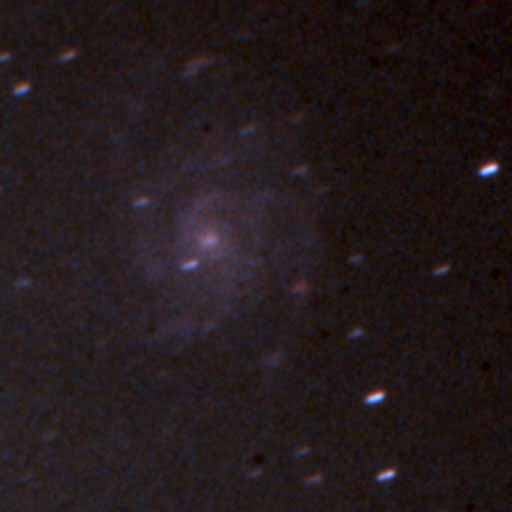
It may have several origins:
- Guidescope slipping off place during exposure (it is currently attached to the main scope, and not directly to the mount)
- Guidescope's focuser moving during exposure (the equivalent of mirror slop in refractors :))
- Imperfect mount alignment, causing field rotation as I was guiding on a bright but distant star. (unlikely the case, as the trail measures 0,145mm (49") on all corners of the 6x6cm frame)
- Too large guiding tolerance (not the case: I use 5"~10" guiding accuracy, this is a 49" trail)
Anyway, I've digitized only 2 slides, and found problems on these 2 only. I still need to digitize 38 more to pay for the scanner, and to find out if other photos suffer from the same problem :) scnning older photos, from when I had a slightly different guide-scope setup, may help in determining the cause and nature of this problem..
Sunday, July 23, 2006
Good sky vs good night
Yesterday night, I went out to photograph the sky again.. The sky was absolutely fabulous; you could see everything! Stars of magnitude 6.3 showed up quite easily at the naked eye. the atmosphere was decently stable as well.. However, it was extremely windy as well. So I didn't risk taking any pictures :( I'll try again next weekend, probably.
Right now I have one 45-minute shot of M31 in the roll of 120 film (6cm x 6cm), so that means I still have arround 12 photos to shoot before sending the film to processing :P
Taking pictures at this rate means I'll have this roll finished in about 4 to 6 sessions.. Which hints at about one month time from now to have the results digitized :)
Right now I have one 45-minute shot of M31 in the roll of 120 film (6cm x 6cm), so that means I still have arround 12 photos to shoot before sending the film to processing :P
Taking pictures at this rate means I'll have this roll finished in about 4 to 6 sessions.. Which hints at about one month time from now to have the results digitized :)
Subscribe to:
Posts (Atom)